
Published April 23, 2026
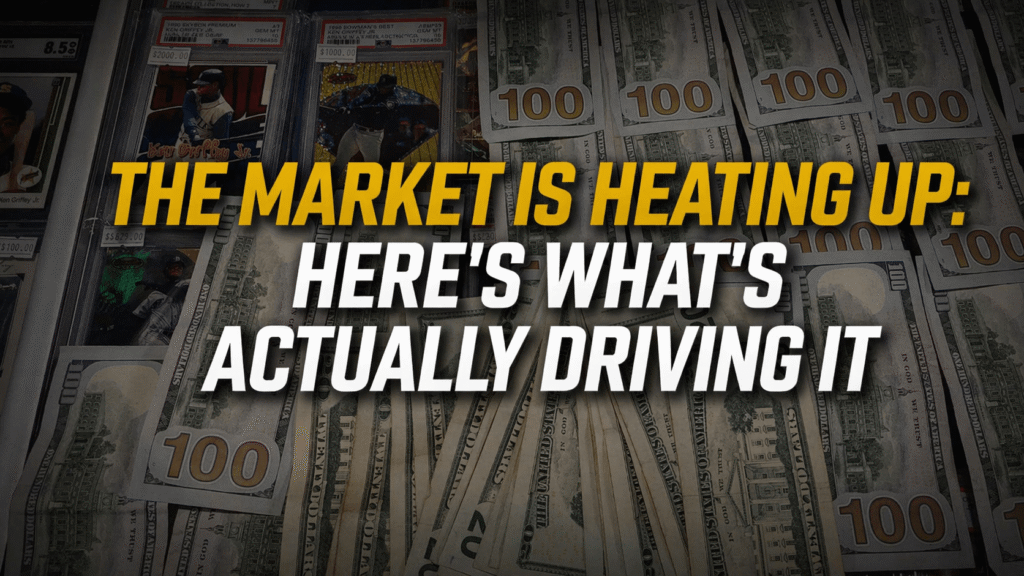
Walk any card show right now and you will see what a hot market looks like. Well before you walk you might notice that you had to park blocks away, but aisles are crowded, dealers are pricing cards above last comp, and the icons are drawing real competition from buyers again. I’ve noticed this personally here in my home state when attending shows in Elizabethtown, Bowling Green and Louisville recently. This isn’t subtle, and it isn’t isolated to one corner of the market.
New case hits are being sold for strong prices every day, look at the Shohei Ohtani Alter Ego sales on eBay or any of the 2026 Topps Chrome football Kaiju inserts for recent ultra-modern examples of this trend.

The late 1980s and early 1990s brought a similar surge in attention and spending. Demand climbed, new collectors entered the space, and prices followed. That run eventually corrected, sharply. It remains one of the most prominent examples of how quickly enthusiasm can accelerate and how abruptly it can cool.
The current run isn’t lifting everything equally. The strongest movement for older cards is concentrated in players with lasting relevance. Michael Jordan, Tom Brady, LeBron James, Ken Griffey Jr, Barry Sanders. This group plus other hall of famers are the players people grew up watching, and that feeling of nostalgia is a big part of what’s driving demand right now. A recent look at sales of the 1996 Bowman’s Best Preview Atomic Refractor Ken Griffey Jr (PSA 10) shows the same pattern.

The collectors who grew up watching those players are now in their 30s, 40s, and 50s. They have more disposable income, and a portion of them are returning to the hobby with a laser guided approach. They are often looking for specific cards, often the same ones they wanted years ago but could not afford or find at the time.
Sites like Fanatics Collect and eBay have made these harder to find cards easier to access. Supply for high-end copies that actually look good is limited, and buyers are competing for the same inventory. You can see it in how certain cards sell. Desirable cards such as the 1993 Ultra Jordan Scoring Kings rarely sit for long, even when listed above the last comp, within reason of course. There’s always someone asking 10k for a card that just sold for 2,500.
At the same time, more people are starting to question how sustainable this is. Hobby voices like Professor Sports Cards have been consistent in pointing out where things start to disconnect from reality. His recent commentary around hype cycles and modern product pricing, particularly releases like Topps Chrome Football, reflects a concern shared by many experienced collectors.
“The system is built on constant growth, like the stock market, built on constantly going up. And I don’t think that’s what we’re going to see here. And I think you should be very aware that when the constant hype, FOMO, shill bidders, when those peaks hit, it’s going to be a fall, a downturn.”
Professor’s perspective should not be ignored, and his concerns are valid. Every market needs participants who are willing to push back when expectations are through the roof. The current environment includes both informed buyers and people chasing momentum, and those are not the same group.
The bigger difference is how people are participating. In this hobby risk often shows up in constant box ripping, participating in breaks, and purchases made without a clear plan, often on credit. They can work in short bursts, but these methods are riskier and can leave investors holding the bag.
Buying singles is less exciting, but it is more sustainable for true collectors. Focusing on players with established legacies, prioritizing eye appeal, and being selective about entry points has historically been a more stable way to participate. It does not remove risk, but it reduces exposure to the most volatile parts of the market.
Huge jumps in value tend to bring in new participants who assume the trend will continue without interruption. That almost never holds up. Markets that rise quickly often correct, and when they do, the move can be just as sharp in the opposite direction.
A blowoff top, if one forms, does not mean the hobby is finished. It means the pace exceeded what the market could support. This pattern shows up across asset classes. The S&P 500 has gone through multiple periods of expansion and contraction. Bitcoin has seen extreme runs followed by deep pullbacks. Classic cars have experienced similar waves of demand, correction, and gradual recovery. As Howard Marks succinctly said:
“Cycles will never stop occurring… When times are good, people conclude the trend will continue forever. When times are bad, they assume it will never end.”
This pattern has consistently played out many times across history.
There is also a psychological component that is easy to overlook. Periods of rapid growth create momentum, and hype is a hell of a drug. At some point expectations exceed what the market can realistically deliver. When that happens, the falloff can be quick and brutal.
That does not invalidate the underlying demand. It simply resets it.
This is where many collectors struggle. They either wait too long to participate because they are worried about buying at the wrong time, or they overcommit during strong runs and find themselves exposed when conditions change. Both outcomes are avoidable with a more measured approach.
The better question isn’t whether the market is too high or too low. It is what you are comfortable holding through a full cycle. If a card still makes sense to you five or ten years from now, short-term volatility becomes less important.
That is why players with lasting cultural relevance continue to anchor the market. New collectors tend to gravitate toward familiar names. Established collectors tend to consolidate into higher-quality examples. That overlap is a big part of what’s driving things, even when prices jump around.
It is also worth remembering why people stay in the hobby in the first place. Cards offer something that most other markets do not. They are tied to moments, memories, and personal history. They provide a break from everything else competing for attention. They provide a space where people come together and exchange perspectives that at the end of the day are lighthearted and fun.
That aspect does not disappear when prices change.
If anything, it becomes more important when things get volatile. Collectors who approach the hobby with a clear plan and realistic expectations tend to navigate these cycles more effectively. They are less reactive to short-term movement and more focused on long-term outcomes.
That does not mean ignoring risk but understanding it and viewing the cycle from 10,000 feet can give us a better idea of where we currently are.
Avoiding unnecessary leverage, staying within a defined budget, and being selective about purchases are basic principles, but they hold up in any market. They also make the experience more sustainable. Constantly chasing price movement, in either direction, usually leads to poor decisions.
The current environment offers opportunity, but it also requires discipline. Prices are rising, interest is strong, and demand for the stars of today and yesterday is absolutely a real thing. At the same time, not everything moving up will hold its value, and not every trend will continue.
That balance is what defines markets like this.
The hobby being “on fire” isn’t the end of the story. It’s just where we are right now. What matters is how collectors respond to it. Those who stay grounded, focus on quality, and accept that volatility is part of the process are more likely to come out of the next phase in a strong position.
Because there will be a next phase.
There always is.