
Published March 2, 2026
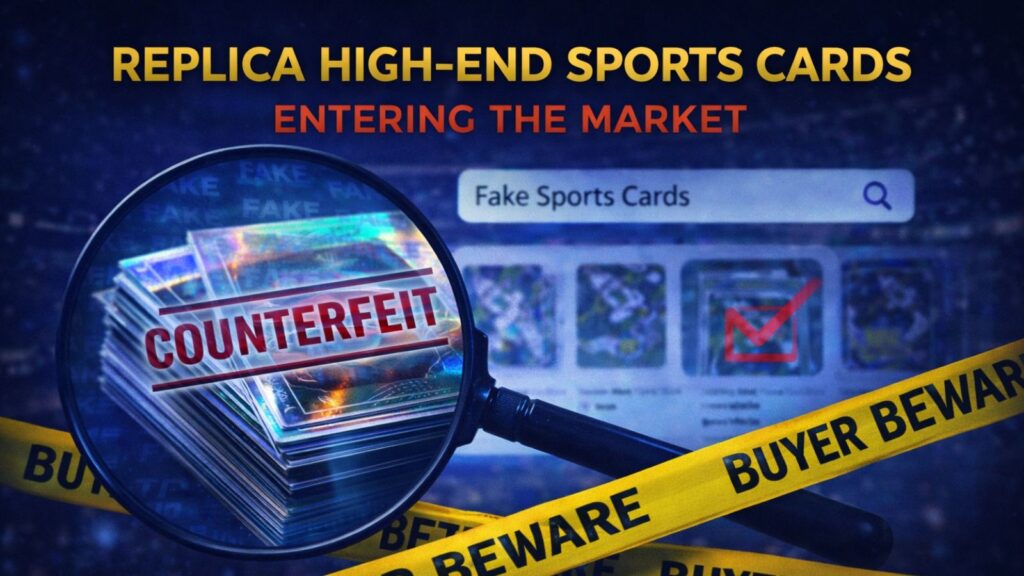
When I’m researching a card, I begin with Google. The path normally runs through eBay, Fanatics Collect, Goldin, and other established auction houses. This time, after enough searches, the algorithm steered me somewhere unexpected, Etsy.
That’s where the red flags started.
I saw Tom Brady Downtown listings at prices that made no sense. To be fair, many sellers describe these as “custom,” “novelty,” or “art” cards. The issue is that some of these listings still mimic the real product closely, including branding elements and card-back layouts that look like official releases.
From there, the rabbit hole widened: Kabooms, Downtowns, Manga inserts, and one case hit after another, all the way up to ultra high-end targets like Tom Brady Bowman Chrome refractor rookies.
Etsy is not the only platform where this shows up, but it’s one of the easiest places to stumble into it, especially if you’re searching broadly on Google. Etsy even has entire marketplace search pages built around terms like “fake downtown cards” and “fake kaboom.”
A quick note on real “art cards”
I’m not anti art-card.
Some custom cards are clearly original, creative work: parody designs, unique themes, or one-off pieces that don’t pretend to be an official release. I’ve also seen creators design genuine 1/1-style pieces around real autographs in a way that’s obviously custom.
That isn’t what concerns me.
The problem is near-replication of expensive, in-demand cards that can later be passed off as authentic to someone who does not know what they’re looking at.
The pipeline risk: Etsy to eBay to card shows
Here’s the part that should make collectors pause.
Once these replica-style cards exist, they do not always stay labeled as “custom.” They can move from “art card” listings into raw resale listings that read like evasive, plausible-deniability descriptions.
I ran into this pattern personally after finding these Etsy-style replicas. Not long after, I saw an eBay auction for a 2000 Bowman Chrome Brady refractor rookie that looked wrong for the price and the seller profile. The seller had zero feedback, the description felt carefully vague, and the price was headed well north of a five-figure windfall for the seller. eBay ultimately canceled the listing and removed the seller. That’s a win, but it also shows how far these things can travel before a platform catches them.
Reddit hobby communities have been calling out this exact “too good to be true” dynamic for months, including posts where commenters explicitly call out a fake Joe Burrow Manga card and point to Etsy-style replicas as the source.
How to protect yourself buying raw on eBay
eBay has buyer protection and, for many higher-end cards, authentication. That helps. It does not replace basic scrutiny.
Use this checklist before buying raw, high-end cards:
- Check feedback, but don’t stop there. Everyone starts at zero, but scammers can also build feedback quickly with low-value transactions.
- Look at the store. Does the inventory look normal, or is it a brand-new account selling one “big” raw card?
- Compare selling pattern vs the card. If everything else is low-end or slabbed and suddenly there’s one massive raw case hit, slow down and ask questions.
- Message the seller. Ask for extra photos: front, back, corners, edges, and close-ups of logos and foil. Real sellers usually respond like real humans.
- Trust the math. If the price is meaningfully below market, assume there is a reason until proven otherwise.
The real danger zone: card shows
The risk isn’t limited to online marketplaces. Late in 2025, hobby creator Mojo Sports documented being sold fake cards at a regional card show, walking through how the cards felt wrong and what made him suspicious, a rare first-hand account of how counterfeit inserts can make it into live hobby environments.
If you buy raw ultra-modern case hits at shows, treat them like high-risk purchases until proven otherwise.
Quick show checklist for ultra-modern inserts
- Feel the card. Many authentic premium inserts have specific texture and finish patterns. Smooth surfaces where texture should exist are a warning sign. A recent 2026 news segment on counterfeit trading cards highlighted texture and surface feel as a key tell.
- Inspect the back and logos. Look closely at league logos and brand marks. Counterfeits often show muddy edges, inconsistent print, or slightly “off” color.
- Use on-site grading when available. If BGS (or another grader) is offering on-site services, ask about a raw card review. These reviews typically take about an hour and provide peace of mind that justifies the fee.
- Buy graded when the card is a common counterfeit target. The added authentication can reduce uncertainty.
The most commonly replicated ultra-modern targets
Downtown (Donruss / Donruss Optic)
- 2022 Donruss Optic Joe Burrow Downtown
- 2022 Donruss Tom Brady Downtown
- 2024 Donruss Drake Maye Downtown
- 2025 Donruss Jaxson Dart Downtown
Kaboom (Panini Absolute)
- 2021 Panini Absolute Tom Brady Kaboom
- 2025 Panini Absolute Jaxson Dart Kaboom
- 2021 Josh Allen Gold Kaboom /10
If you buy any of these raw, you should assume you’re in a higher-risk lane than a normal base rookie purchase. That doesn’t mean every raw copy is fake. It means these are the exact designs counterfeiters like to copy because demand is constant and buyers often rely on photos instead of print/foil inspection.
Counterfeiting Is Not a Hobby Rumor
This is not a niche or isolated issue. Counterfeiting is a global industry.
According to a February 20, 2026 InvestigateTV report, the global counterfeiting trade reached an estimated $467 billion in 2021 and has likely grown since. U.S. Customs and Border Protection reported counterfeit seizures more than doubled between 2020 and 2024. Trading cards are now part of that broader trend.
In the report, hobby shop employees described seeing fake trading cards weekly, often brought in by customers who purchased them through third-party sellers or online marketplaces. Texture inconsistencies, incorrect border coloring, and light-pass tests using a phone flashlight were cited as common ways to identify fakes.