
Published March 11, 2026
Buying a card online has never been easier.
A few clicks, a payment confirmation, and the deal is done. Marketplaces make it simple to compare copies, check recent sales, and find the exact card you want.
For many collectors, the stressful part begins after that.
Once the card enters the shipping system, it is largely out of your control. A high-value purchase may move through several hands before it ever reaches the buyer. The seller ships the card to a carrier. In many cases the package is routed to an authentication facility. After inspection, it goes back into the shipping network for delivery.
Each step is designed to protect collectors from fraud. Every additional stop also creates another point where something can go wrong.
That routing is now common for many hobby transactions. eBay’s Authenticity Guarantee program automatically sends eligible cards through an authentication partner before delivery.
eBay explains on its trading card Authenticity Guarantee page:
“Eligible items will have the Authenticity Guarantee checkmark in the listing and will automatically go through the authentication process once purchased.”
For collectors buying inexpensive singles, the process may feel routine. For someone waiting on a four-figure card or an iconic rookie, it can feel very different.
The purchase itself takes seconds.
The waiting can take days or weeks in some cases.
And during that time the card is moving through a system the buyer cannot see or control.
Package theft is not rare, and it is not limited to one carrier
Collectors sometimes talk about missing packages as if they are rare accidents.
The broader data suggests otherwise.
Package theft has grown into a large national problem across the entire delivery ecosystem. The issue affects all major carriers and many categories of goods shipped through the mail.
The United States Postal Service Office of Inspector General estimates that tens of millions of packages disappear each year.
In its 2025 white paper on package theft, the agency reports:
“With at least 58 million packages stolen in 2024, theft creates substantial financial burdens and operational disruptions across the delivery and ecommerce ecosystems.”
The same report notes that outside studies estimate billions of dollars in losses annually from stolen deliveries. Average reported values vary depending on the survey, but commonly fall between roughly $50 and $200 per package.
Importantly, the problem is not concentrated with a single shipping company.
Consumer surveys consistently show theft occurring across all major carriers. Guardian Protection’s recent theft analysis cited victim reports involving Amazon deliveries in about 33 percent of cases, USPS roughly 18 percent, FedEx around 17 percent, and UPS about 16 percent.
Another package theft summary shows a similarly broad distribution of incidents, with UPS appearing in roughly 31 percent of reports, FedEx about 29.7 percent, and USPS around 28.8 percent.
The takeaway is simple. No carrier is immune.
When a package disappears, the odds are good that the problem did not start with the seller or the buyer. It is often a consequence of the enormous shipping network that modern ecommerce depends on.
For collectors waiting on a valuable card, that reality can make the tracking page feel a little more stressful than usual.
Cards are uniquely exposed because they are small, valuable, and easy to move
Not every package moving through the delivery system carries the same risk.
Trading cards have several characteristics that make them unusually attractive targets for theft. A valuable card can fit inside a small padded envelope, weigh almost nothing, and hold significant resale value. Unlike larger consumer goods, it can be concealed easily and resold quickly through online marketplaces, social media, hobby forums, or card shows.
That combination makes sports cards and TCG cards different from most items shipped through the mail.
A single envelope can contain hundreds or thousands of dollars in collectibles.
Modern hobby practices have also increased how often valuable cards travel through shipping networks. Authentication programs, grading submissions, and online marketplace sales all require cards to move between collectors, companies, and buyers.
Authentication services have become one of the most visible examples. Many higher value online purchases are now routed through a verification step before reaching the buyer.
On its trading card Authenticity Guarantee page, eBay explains:
“Eligible items will have the Authenticity Guarantee checkmark in the listing and will automatically go through the authentication process once purchased.”
In practical terms, that means a single purchase may travel through multiple shipping legs before it reaches its final destination.
A typical path might look like this. The seller ships the card to a carrier. The carrier delivers it to an authentication facility. After inspection, the card is placed back into the shipping system and sent to the buyer.
Each step serves an important purpose. Authentication protects collectors from counterfeit or altered cards.
But every additional stop also means more handling, more scanning, and more time spent moving through the delivery network.
Grading submissions create a similar dynamic. Professional Sports Authenticator (PSA), one of the largest grading companies in the hobby, reports that it has certified tens of millions of collectibles since its founding.
PSA states on its company history page that it has graded more than 65 million items.
Every one of those submissions required a collector to ship cards to the grading company and then receive them back once the process was complete.
When you combine grading submissions, authentication routing, and the constant movement of cards through online marketplaces, it becomes clear why so many valuable cards spend time in transit.
Hobby communities keep reporting the same problems
There is no comprehensive public dataset tracking missing or damaged sports card shipments specifically.
The pattern appears frequently in hobby communities. Collectors frequently share stories about packages arriving damaged, slabs cracking during transit, or cards disappearing somewhere along the shipping chain.
These reports should be viewed as anecdotal evidence rather than formal statistics. Still, the consistency of the stories across different platforms and sports is difficult to ignore.
Sports cards and authentication damage
Many of the most common complaints involve cards moving through authentication programs or high value shipments.
On Reddit, collectors regularly describe issues ranging from cracked slabs to damaged cards during authentication handling.
One r/baseballcards user wrote:
“Sold a card for $350 and it got rejected because eBay authenticators damaged it.”
Similar concerns appear in other sports card communities.
In one r/basketballcards thread titled “eBay Authentication damaged my card,” a collector wrote:
“Had a PSA 10 come back from eBay cracked.”
Other collectors report packages arriving opened or missing contents entirely. In one r/footballcards discussion, a user shared photos (pictured below) of a shipping envelope that arrived ripped open with the card missing.
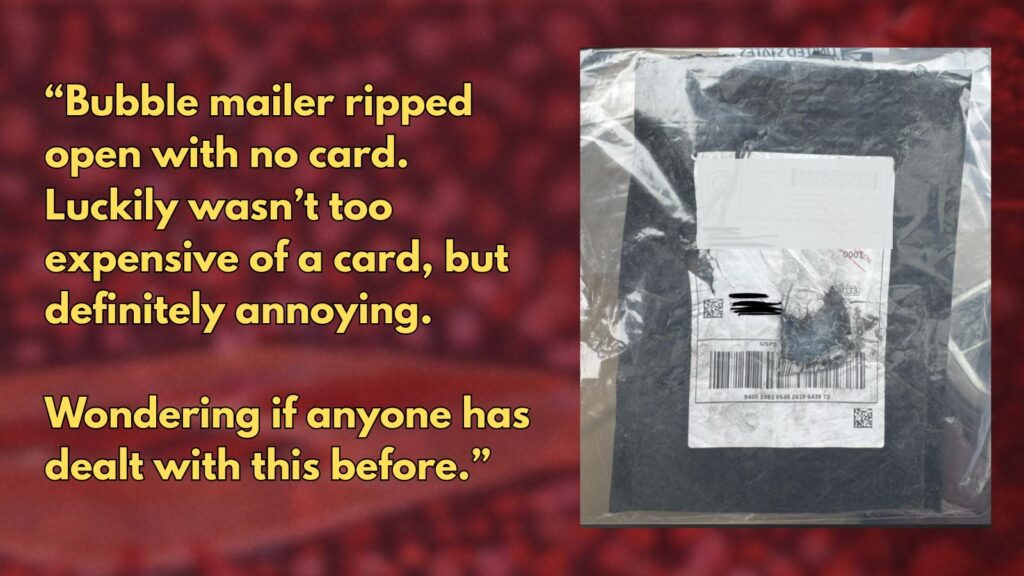
These examples do not prove that authentication programs or shipping systems frequently damage cards. But they do illustrate the types of problems collectors worry about when a valuable purchase enters the mail.
A recent example involving a well known hobby figure
High profile collectors occasionally experience the same issues.
Sports card influencer Ty Wilson from the Chasing Cardboard YouTube channel recently reported that a large shipment of cards went missing while being transported by UPS.
“UPS lost one of my twelve boxes during shipping. So, if you happen to receive a random fifty-five-pound box of relics and autos, it’s mine.”
Incidents like this circulate widely in hobby circles because they reinforce a concern many collectors already feel when shipping high-value cards.
TCG collectors report similar problems
The same concerns appear in the trading card game community.
On r/pokemoncards, one collector described sending two insured submissions to grading companies through FedEx.
“When they arrived, 34 cards were missing from the PSA package and 10 from Beckett.”
Other Pokémon collectors describe packages delayed for weeks or shipments that appeared to be opened during transit.
While individual stories cannot establish how often these incidents occur, they highlight how much value can be concentrated inside a single grading submission.
Long running hobby discussions about missing packages
These conversations are not limited to Reddit.
Blowout Cards Forums, one of the hobby’s longest running discussion boards, contains years of posts about lost shipments and insurance disputes.
One thread titled “Sick to my stomach: USPS lost a VERY high-end package” details a collector’s experience after a valuable shipment disappeared in transit.
Other threads discuss missing grading submissions and the challenges collectors face when filing claims for lost or stolen packages.
The recurring nature of these discussions does not prove that shipping problems are common. But it does show that collectors across multiple corners of the hobby have encountered similar issues.
For someone waiting on an important card, even a small number of incidents can make the shipping process feel far more stressful than the purchase itself.
Authentication reduces fraud, but it also adds friction
Authentication programs were introduced to address a real problem in the hobby.
Counterfeit cards, altered surfaces, trimmed edges, and misleading listings have all been persistent concerns in the online marketplace. By routing certain purchases through professional authenticators before delivery, companies like eBay aim to prevent fraudulent cards from reaching buyers.
In many cases, the system works as intended. Cards that fail inspection are intercepted before they ever reach the buyer, protecting collectors from expensive mistakes.
But the added protection also changes the shipping process.
Instead of traveling directly from seller to buyer, many higher value cards now move through an additional stop before final delivery. The seller ships the card to an authentication facility. After inspection, the card is repackaged and sent back into the carrier network for delivery to the buyer.
Each additional step adds time in transit and more handling along the way.
That does not mean authentication increases the chance of problems. But it does mean the card spends more time moving through the shipping system before it arrives.
eBay describes the final step of that process on its Authenticity Guarantee help page:
“If the item passes inspection and is a trading card, it will be shipped to the buyer with 4 day secure delivery.”
The same page notes that signature confirmation is required for certain higher value shipments moving from the seller to the authentication partner.
For collectors, that extra layer of verification is often worth it. Authentication has prevented many counterfeit and altered cards from slipping through online marketplaces.
At the same time, the process adds another stage to the journey.
For a buyer waiting on an important card, that additional step can make the wait feel longer and the tracking page feel a little more important.
Why many collectors still prefer buying big cards in person
For all the convenience of online marketplaces, many collectors still prefer to buy their most important cards in person.
Card shows and local shops remove several of the risks that come with shipping valuable collectibles. There is no package moving through a carrier network. No waiting for authentication routing. No wondering whether the card will arrive safely after several days in transit.
The card changes hands directly between buyer and seller.
That difference can matter when the purchase involves an expensive or historically significant card.
Buying in person also allows collectors to evaluate details that are difficult to judge from photographs alone. Online listings can hide subtle issues depending on lighting, angles, or camera settings. A card that looks sharp in a listing photo may appear very different under normal light.
When the card is in hand, collectors can examine the details that matter most.
- Centering
- Surface condition
- Corners
- Print quality
Those small details often determine whether a particular copy stands out from others with the same grade.
This matters most with iconic cards where visual differences can be significant even within the same grade. Two cards may carry identical grades but present very differently when viewed side by side.
In those situations, seeing the card in person can change the entire evaluation.
There is also the simple fact that buying locally removes the uncertainty that comes with shipping. The transaction is complete the moment the card changes hands.
The price on a show floor or in a shop may sometimes be slightly higher than the cheapest online comp. But for many collectors, eliminating the shipping risk is part of the value.
That reality helps explain why card shows and hobby shops remain an important part of the collecting experience, even in an era where most cards can be purchased with a few clicks.
Closing
The anxiety many collectors feel while waiting on a high value card to arrive is not irrational.
Cards today often move through more shipping steps than they did even a few years ago. Authentication programs, grading submissions, and the sheer scale of online marketplaces mean that valuable collectibles spend more time in transit than ever before.
At the same time, package theft and shipping issues remain a reality across the broader delivery system. Millions of packages disappear each year in the United States alone, and even a small percentage of problems can feel significant when a single envelope contains something valuable.
On the positive side, most cards arrive safely. Carriers move an enormous number of packages every day, and authentication services have helped reduce fraud in the hobby.
But the process still requires a level of trust.
Once a card leaves the seller’s hands, the buyer has little control over the journey that follows. It is simply part of the modern hobby experience.
Understanding that risk does not mean avoiding online purchases altogether. It just means recognizing that the price of a card online does not always capture the full experience of buying it.
Sometimes the real cost includes the wait.