
Published March 9, 2026
Spend enough time in the hobby and you will hear the same advice repeated again and again:
Buy the card, not the grade.
It sounds simple, almost cliché. But the meaning becomes clearer the moment you have multiple copies of the same card in front of you.
That situation came up recently while I was searching for a copy of the 1986 Fleer Michael Jordan rookie, one of the most studied and recognizable cards in the hobby.
Over the course of a few months, I looked at several copies in the same grade. My quest took me to card shops, card shows and even tracking a few on eBay.
What quickly became obvious was that not all cards with the same grade actually look the same.
What “buy the card, not the grade” actually means
The phrase itself has circulated among collectors for decades, often phrased slightly differently as “buy the card, not the holder.”
In practice, the phrase means something simple: grading provides a useful condition benchmark, but it should not replace the collector’s own evaluation of the card.
As one hobby article explains:
“Collectors should pursue cards that they personally like instead of how they may be scored by a third-party grader.”
The numerical grade is only part of the story. Two cards with the same label can still look very different when examined closely.
Grading itself is based on several factors including corners, centering, edges, and surface quality.
Because those attributes can combine in different ways, a card that technically qualifies for a particular grade may still present very differently to the eye.
Six copies of the same card
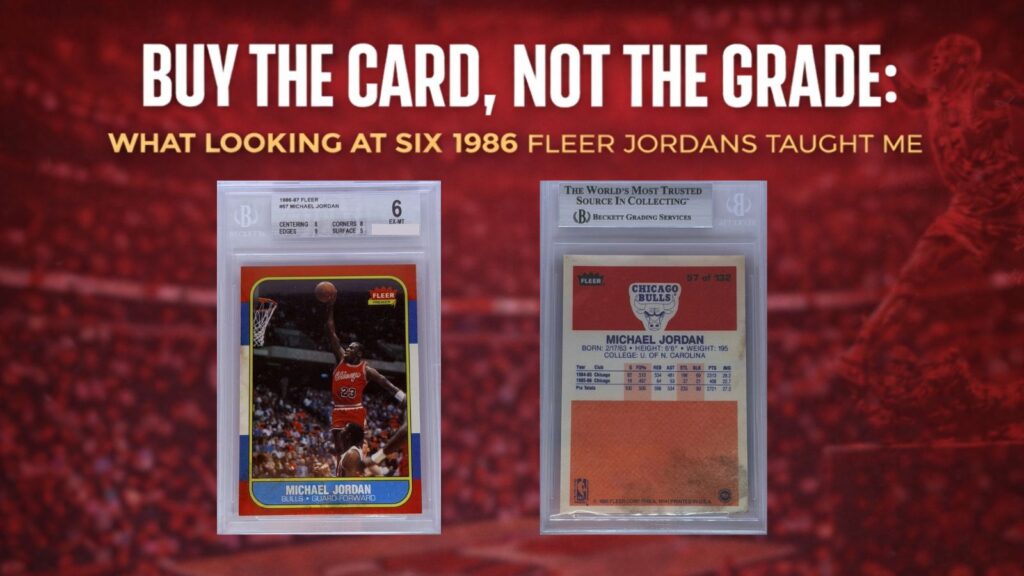
While evaluating 1986 Fleer Jordans, I reviewed six BGS 6 copies.
Despite sharing the exact same grade, the differences were noticeable.
One copy (pictured at the top of the page) had noticeably weaker top to bottom centering. It also appeared dirty, particularly along the front left edge and across the lower half of the back.
Another example I tracked on eBay had significant red ink marks across the back. The left-right centering was also not visually appealing in my opinion. Below is that copy next to the one I ultimately chose.
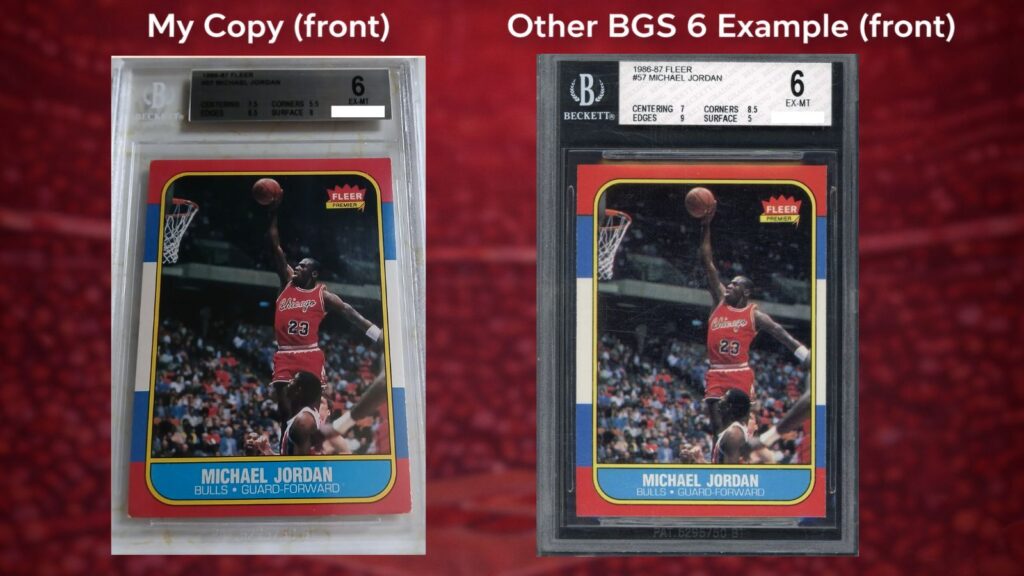
All of these cards technically met the criteria for a BGS 6. But visually they presented very differently.
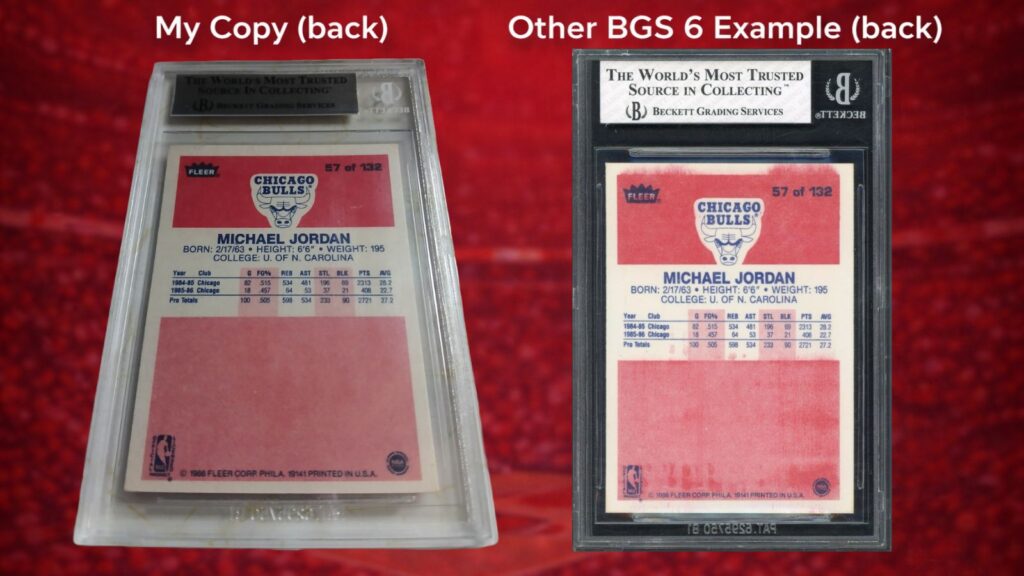
That’s something most collectors eventually notice. Cards can share the same grade and still look completely different once you see them side by side.
That’s where the idea of buying the card rather than the grade starts to make sense. In my case, it also meant paying a little more for the copy that looked best.
Why I paid more for one copy
The copy I ultimately purchased cost a few hundred dollars more than other examples in the same grade range.
The centering was noticeably stronger, and the surface was far cleaner. The back looked crisp with no signs of wear or ink bleeding. When placed next to other copies I had been tracking, the difference was obvious, at least to me.
There was one tradeoff. The corners show minor imperfections, though nothing close to rounding. Still, flaws like that can weigh heavily in the grading process.
But to me it did far less damage to the card’s overall eye appeal than some of the other issues I saw. Several of the other examples had noticeably worse centering or surface scratches.
Those flaws tend to stand out immediately when you look at the card. By contrast, the slightly imperfect corners are something I only noticed under closer inspection and, in my view, looks minor compared with the flaws on the other examples. Of course, other collectors may feel differently.
Why this happens more with older cards
Vintage and early modern cards were often produced with less consistent printing and cutting standards than modern issues. As a result, cards from the same set often show large variations in centering, surface quality, and edge wear. The Just Collect article “Everything You Need to Know About Grading Vintage Baseball Cards” explains that vintage cards frequently show issues such as minor print imperfections, off-center cuts, and edge wear even within similar grade ranges.
Collectors often discuss this dynamic in hobby forums.
One collector writing on the Collectors Universe boards explained that eye appeal can dramatically influence buying decisions:
“I’d probably pay from 1–2 grades up depending on the card… if it meets the eye appeal you are looking for.”
Many collectors are willing to pay a little more for the copy that simply looks better.
Even grading companies can disagree
The idea that two cards with the same grade can look different is widely accepted in the hobby. What surprises many collectors is how much grading opinions themselves can vary.
A recent experiment by Tyler Nethercott of Sports Card Investor and Sports Cards HQ illustrates the point clearly.
Nethercott took a single card, a 1989 Upper Deck Ken Griffey Jr. rookie, and submitted the same copy to multiple grading companies over time. After each result, the card was cracked out of the slab and sent to another grader. The process was repeated nine separate times.
The results were dramatic.
During the video experiment, Geoff Wilson summarized the grading history of the same physical card:
“You started with the 1989 Ken Griffey Jr. rookie card in a BGS 9.5… sent it to SGC and it came back authentic evidence of trimming… sent it to CGC and it graded a CGC 9… then PSA graded it a PSA 6.”
At one point the card was rejected for being oversized, while another company had previously flagged it for trimming, essentially the opposite issue.
Wilson continued summarizing the grading cycle:
“Then you send it back to SGC, who previously said it was trimmed, and this time SGC grades it a nine. Then you send it back to PSA, who previously graded it a six, and this time PSA grades it an eight.”
Eventually, when the card returned to Beckett, the company that had originally graded it highly, the conclusion changed again.
“Then you send it back to BGS who originally graded it a 9.5 and BGS grades it as altered trimmed.”
Nethercott confirmed the sequence during the discussion.
“That’s the life cycle of the Griffey… I didn’t do anything along the way. I didn’t trim it. It’s been quite a journey.”
The experiment does not necessarily mean grading is unreliable. But it does highlight an important reality: grading remains an evaluation process performed by humans, and opinions can vary depending on the submission, the grader, and the specific standards applied at the time.
The takeaway from this experiment is that the label provides useful information about condition and authenticity, but it does not replace evaluating the card itself.
Examples like this reinforce why collectors still rely on their own evaluation of a card rather than the label alone.
Where eye appeal matters most
The “buy the card, not the grade” concept tends to matter most in a few specific areas of the hobby. These are situations where visual differences inside the same grade can be significant and where collectors regularly prioritize eye appeal over the number on the label.
Vintage and early modern cards
Older cards were produced using printing and cutting processes that were far less consistent than modern manufacturing.
As a result, cards from the same set can vary widely in centering, color registration, and edge quality. Two cards graded identically can present very differently when viewed side by side.
Collectors often focus on the visual presentation of vintage cards rather than the technical grade alone. As David Solow of Sports Illustrated explained in his article “The Art of Eye Appeal: What Collectors Really Look for in Vintage Cards”:
“Buy the card, not the holder has become a golden rule among vintage collectors.”
This is especially true with sets printed before the mid-1990s, when production technology improved and card stock became more consistent.
For example, early Upper Deck cards like the 1989 Ken Griffey Jr. rookie were printed on large sheets where certain positions were more susceptible to poor cuts or damaged corners.
Even when graded, those production variables can lead to noticeable differences between cards within the same grade.
Iconic rookie cards
The principle becomes even more important when collectors evaluate the hobby’s most recognizable rookie cards.
Cards such as:
- 1986 Fleer Michael Jordan
- 1952 Topps Mickey Mantle
- 1989 Upper Deck Ken Griffey Jr.
Discussions across hobby forums frequently reflect this behavior. One experienced collector explained the strategy simply:
“The key is to buy a 5 that looks like a 7 or 8 but pay the 5 price.”
This approach allows collectors to acquire visually strong examples while staying within their budget.
Border-sensitive sets
Some sets make condition issues far more visible than others.
Cards with colored borders tend to highlight wear more clearly than white-bordered cards. Even small edge chips or corner wear can become obvious.
Examples include:
- 1986 Fleer Basketball (Jordan rookie set)
- 1971 Topps Baseball (black borders)
- 1962 Topps Baseball (wood-grain borders)
Because border wear is so visible, two cards graded the same can look dramatically different in hand. A card with cleaner borders and stronger centering will often command more attention from collectors.
As one forum collector post put it:
“A nice looking card stands out in any holder.”
Low-grade vintage examples
Another place where “buy the card, not the grade” becomes important is with lower-grade vintage cards.
For iconic cards that are financially out of reach in high grade, collectors often pursue lower-grade examples that still present well visually.
A mid-grade example can offer a way to own historic cards at a fraction of the cost. Even grading companies acknowledge that collectors often pursue mid-grade examples because they provide accessibility without requiring the price of near-mint copies.
In these situations, collectors often prioritize stronger centering and cleaner surfaces even in lower grades.
A well-centered card with strong color and a small crease may be more desirable than a higher-graded example with poor centering or distracting surface flaws.
When the grade matters more
That said, grading still plays an essential role in the hobby.
Third-party grading became widely adopted in the 1990s in part because it helped authenticate cards and standardize condition across the marketplace. By assigning a numerical grade, companies like PSA and Beckett created a framework that allowed collectors and investors to compare cards with a common reference point.
In certain segments of the hobby, the grade itself carries significant weight, sometimes more than small differences in visual presentation.
Ultra-modern inserts
Ultra-modern cards are typically printed with tighter manufacturing tolerances than older issues. As a result, most cards come out of the pack in strong condition. The difference between a PSA 9 and PSA 10 often comes down to extremely small flaws such as a minor print line, slight centering shift, or microscopic surface mark.
Because of that, the market frequently places a heavy premium on the highest grade available.
This is particularly true for some of the hobby’s most sought-after modern inserts, including:
- Kaboom!
- Downtown
- Color Blast
- Blank Slate
- Stained Glass
These inserts are known for their artwork and rarity. Modern inserts like Kaboom, Downtown, and Color Blast have become some of the most recognizable chase cards of the last decade.
Population data illustrates how grading impacts these cards. According to grading tracker GemRate, PSA has graded more than 45,000 Kaboom cards, but only about 36% achieved a PSA 10.
That scarcity can drive major price gaps between grades.
Across many modern cards, PSA 10 examples often command multiples of the PSA 9 price. In some cases, gem-mint copies can sell for several times the price of the same card graded PSA 9, even when the visual differences are subtle.
Registry competition and population scarcity
Another area where grading becomes especially important is registry competition.
Collectors participating in registry sets often pursue the highest graded examples possible in order to rank higher on public leaderboards. In those cases, the grade itself becomes the defining factor.
Population reports reinforce this dynamic. Because every PSA 10 is by definition rarer than the PSA 9 population below it, collectors chasing top-graded examples frequently drive premiums for gem-mint copies.
For investors, that scarcity can become the central thesis behind a purchase.
The trade-off
Even in segments where grading matters most, collectors still notice eye appeal.
A PSA 10 label may carry the strongest market premium, but collectors often prefer gem-mint copies that also display strong centering, clean surfaces, and balanced borders.
The grade may set the price tier.
But the card itself still determines which example collectors want to own.
What collectors should actually look for
When comparing cards in the same grade, experienced collectors often focus on several visual factors:
Centering
Is the image balanced on the card?
Edges
Are there chips or fraying, especially on colored borders?
Corners
Do they remain sharp under magnification?
Surface quality
Are there scratches, print lines, or stains?
Print defects
Ink marks, misprints, or color inconsistencies.
Overall eye appeal
How the card presents when viewed as a whole.
These small differences can significantly influence how desirable a card is to collectors.
The label isn’t the whole story
Grading has brought structure and confidence to the hobby.
But the card itself still matters.
Two cards may share the same grade, yet present very differently when viewed side by side. That reality is why experienced collectors continue to repeat the same advice to newcomers.
Buy the card, not the grade.
In the end, collectors do not own the label.
They own the card inside it.