
Published March 30, 2026
The Divide in the Hobby
Spend a few minutes in any comment section, live stream, or hobby podcast and a pattern becomes obvious. Fanatics has become one of the most debated topics in modern card collecting.
The tone is often sharp. Not always, but often enough to notice.
Some creators frame Fanatics as a long-term threat to the hobby’s structure. Others see it as a necessary evolution. Most fall somewhere in between, even if the loudest voices tend to lean one way or the other.
The common concerns are consistent.
Fanatics wants to control the entire ecosystem, from licensing to distribution to resale.
They are pricing out traditional collectors, especially those who built the hobby over the last two decades.
They are reshaping the space around profit, scale, and corporate incentives rather than collector experience.
Those points come up repeatedly, whether the discussion is about product pricing, licensing deals, or the growing presence of Fanatics-backed platforms and events.
At the same time, there is a quieter perspective that doesn’t get as much attention. One that views the same changes through a different lens. More capital, more visibility, and more structure could also mean a larger and more stable hobby over time.
This isn’t a defense of Fanatics.
It’s a closer look at the arguments being made, and whether they hold up when you step back and look at how the hobby actually functions today.
The Core Criticism: Control and Consolidation
The strongest criticism of Fanatics starts with structure.
Over the last few years, the company has moved into nearly every layer of the sports card ecosystem at the same time.
Licensing sits at the center of it. Fanatics has secured long-term, exclusive agreements with the NFL, NBA, MLB, and other major leagues. Those deals determine who can legally produce fully licensed cards.
That control doesn’t stop at licensing.
Fanatics acquired Topps. It now produces cards. It distributes them. It operates direct-to-consumer channels. And with the expansion of Fanatics Collect, it is also building a presence in the secondary marketplace.
From a business standpoint, it’s vertical integration.
From a collector standpoint, it feels like consolidation.
That distinction is where most of the tension comes from.
Critics argue that when one company controls licensing, production, and distribution, competition naturally shrinks. Fewer competitors means fewer alternative products, fewer pricing checks, and less flexibility for both collectors and hobby shops.
That concern has already made its way into legal challenges.
Daniel Kaplan, in “New Suit Alleges Fanatics ‘Monopoly’ Increased Trading Card Prices,” Front Office Sports, states,
“Fanatics and its partners… illegally monopolized the trading card market.”
Even beyond lawsuits, the broader industry tension is visible in how competitors and observers talk about the shift.
Ben Strauss, in “It’s Fanatics vs. Panini in a bitter fight to control the sports card industry,” The Washington Post, states,
“Some stakeholders do worry about Fanatics accumulating too much power.”
The fear isn’t just about today’s pricing or product lineup.
It’s about what happens when one company becomes the central gatekeeper.
Less competition can mean less pressure to innovate. It can mean less transparency in how products are priced and distributed. It can also mean fewer paths for smaller companies, local shops, or independent creators to operate within the space.
Those concerns aren’t baseless. Consolidation changes how any market behaves.
The Growth Argument: Capital Changes the Ceiling
The criticism around control is clear.
The counterpoint is scale.
Fanatics brings something the hobby has never really had at this level. Capital, coordinated marketing, and the ability to push trading cards into a broader, more mainstream audience.
Before this shift, the hobby was strong but contained.
It was driven by collectors, shops, shows, and a handful of manufacturers. Growth happened, but it was uneven. Visibility depended heavily on word of mouth, niche media, and organic cycles tied to player performance.
That model worked. But it also had limits.
Fanatics is operating with a different ceiling in mind.
Michael Rubin, in “Fanatics CEO Michael Rubin says trading cards business could be 10x bigger,” CNBC, states,
“We think the trading cards business can be 10 times bigger than it is today.”
That kind of growth doesn’t come from incremental changes.
It requires investment. It requires distribution channels that reach beyond hobby shops. It requires partnerships, media exposure, and consistent product visibility across platforms that weren’t previously part of the card ecosystem.
Fanatics has already started pushing in that direction through large-scale events, athlete partnerships, and integration with its broader sports commerce network.
Eben Novy-Williams, in “Fanatics is trying to turn trading cards into a mainstream business,” Sportico, states,
“Fanatics is betting it can take what has long been a niche hobby and make it a mass-market business.”
That shift is where the debate really sits.
Growth at that level almost always comes with tradeoffs. More capital usually brings more structure. More structure usually brings more control.
But it also raises the ceiling.
A larger audience means more demand. More demand supports stronger long-term pricing, deeper liquidity, and a wider base of participants entering the hobby at different levels.
The same scale that worries collectors is also what allows the hobby to grow beyond itself.
Does Growth Actually Help Collectors?
Growth sounds good on paper. More attention, more buyers, more activity.
The real question is whether that growth translates into something meaningful for collectors.
Value Expansion
More exposure usually leads to more demand.
That’s not unique to trading cards. It’s how most collectible markets behave when they move from niche to mainstream.
As more people enter the hobby, the pool of potential buyers expands. When that demand concentrates around key cards, prices tend to follow.
We’ve already seen versions of this play out over the last few years.
Nick Bell, in “Sports trading cards surge during pandemic as collectors return,” Reuters, states,
“Demand for sports trading cards has surged as a new generation of collectors enters the market.”
That demand doesn’t spread evenly. It tends to focus on recognizable names, iconic cards, and high-grade examples.
The Jordan market is a clean example of how this works over time.
Performance matters. Championships matter. But visibility matters just as much. Decades of marketing, media exposure, and cultural relevance have kept Michael Jordan at the center of the conversation long after his playing career ended.
That sustained attention supports sustained demand. And sustained demand is what keeps key cards relevant and valuable across generations.
The same principle applies as the hobby grows.
More exposure doesn’t guarantee every card increases in value. But it raises the ceiling for the cards that already carry significance.
Liquidity and Participation
Growth also changes how easily cards move.
A larger audience means more buyers and more sellers. That increases transaction volume and makes it easier to find a market for both high-end and mid-tier cards.
Joe Orlando, in “Why trading cards are hotter than ever,” Sports Collectors Daily, states,
“The more people that participate in the hobby, the more liquid the marketplace becomes.”
Higher liquidity matters.
It reduces the time it takes to sell. It improves price discovery. It gives collectors more confidence that there will be a buyer on the other side when they decide to move a card.
It also supports different types of participation.
Some collectors focus on long-term holds. Others buy and sell more actively. A larger, more active market makes both approaches easier to execute.
Where It Lands
Growth does tend to help asset values, especially at the top end of the market.
It also makes the hobby easier to enter and exit from a transaction standpoint.
But it can change accessibility.
As more money flows into the space, the best cards often move further out of reach. That tension sits at the center of the current debate.
The Pricing Debate: Are Collectors Being Pushed Out?
The pricing criticism is the most common one, and it’s the easiest to understand.
High-end wax is expensive. In many cases, far more expensive than it was even five or ten years ago.
That part isn’t really up for debate.
Walk into any shop or scroll through product releases and the gap is obvious. Boxes that once felt premium are now considered mid-tier. True high-end products often sit at price points that put them out of reach for most collectors.
That shift has fueled the idea that collectors are being pushed out.
But the structure of the hobby hasn’t actually changed as much as it might seem.
It has always been tiered.
There have always been entry-level products aimed at kids, casual collectors, and set builders. There have always been mid-tier releases with a mix of accessibility and chase. And there have always been high-end products designed around rarity, presentation, and bigger hits.
A product like National Treasures has always been positioned as a premium chase product, but today more collectors are seeing it opened than ever before.
What has changed is visibility and awareness.
More people now see the highest-end products through breaks, social media, and influencer content. Those products are no longer tucked away. They are front and center, opened live, clipped, and shared.
That exposure can distort expectations.
Collectors aren’t just comparing products within their budget anymore. They’re comparing everything at once.
Adam Gray, in “Why are sports card boxes so expensive now?” Sports Card Investor, states,
“The biggest driver of higher wax prices is demand for high-end hits, especially from new entrants chasing big pulls.”
That demand feeds directly into pricing.
Manufacturers build products around chase cards. If the market is willing to pay more for those hits, the price of the product adjusts to reflect that.
This is where the disconnect starts.
The issue isn’t that premium products exist. They always have.
It’s that more people now expect access to them.
The frustration isn’t that premium products are expensive. It’s that more people expect access to what was always designed to be out of reach.
That doesn’t mean the concern should be dismissed.
Pricing can overshoot. Products can miss. And if value doesn’t align with cost over time, collectors adjust quickly.
But the presence of expensive products alone isn’t new.
What’s new is how many people are watching them.
The “Pulling Hits” Problem
A lot of the frustration around pricing shows up in a specific way.
People want a real shot at pulling something big without spending a lot to get there.
That idea sounds reasonable on the surface. It’s also where expectations start to separate from how the product is designed.
Most modern releases are built around a chase.
A small number of cards carry a large percentage of the product’s perceived value. Those cards are intentionally hard to pull. That scarcity is what gives them weight in the market.
If those same cards were easier to hit, the entire structure changes.
Chris Carlin, in “Understanding scarcity in sports cards,” Sports Collectors Daily, states,
“Scarcity has always been a key driver of value in the sports card market. When something is easy to find, it rarely holds long-term premium value.”
That principle shows up across every level of the hobby.
Short prints. Serial-numbered parallels. Case hits. All of it exists to control supply.
The tension comes from how visible those hits have become.
Break clips, social posts, and live streams highlight the best outcomes. You see the one-of-one. You see the golds. You see the massive pulls. What you don’t see as often is the volume of boxes that don’t produce those results.
That creates a gap between expectation and reality.
Manufacturers aren’t designing products for everyone to hit big. They’re designing products where a small percentage of outcomes drive the entire chase.
If everyone could pull those cards cheaply, they wouldn’t hold the same value when they do surface.
Scarcity leads to desirability. Desirability supports value.
Change the first part, and the rest doesn’t hold.
Influencers, Sponsorships, and Bias
Another layer of the criticism centers around influencers.
The argument is that if creators are sponsored by Fanatics or aligned with its platforms, their content may lean more positive than it otherwise would.
That concern isn’t unique to cards.
It exists in every industry where media and money intersect. Sports, sneakers, tech, finance. Anywhere there’s an audience, there are sponsorships.
Content creation is not free. Equipment, time, editing, and distribution all cost something. At scale, most creators either monetize or stop producing consistently.
The presence of sponsorship alone doesn’t make the information unreliable. But it does change how it should be viewed.
The Federal Trade Commission has already addressed this dynamic broadly.
The Federal Trade Commission, in its “Disclosures 101 for Social Media Influencers” guidance, states,
“Influencers must clearly and conspicuously disclose their relationships to brands when endorsing or promoting products.”
That guidance exists because sponsorship is expected, not because it’s unusual.
Within the hobby, the same dynamic applies.
Some creators will lean positive. Others will push back harder. Most fall somewhere in the middle, balancing access, relationships, and audience expectations.
Jacob Camenker, in “The rise of breaking and influencers in sports cards,” Sporting News, states,
“Content creators and breakers have become a major part of how collectors experience the hobby today.”
That influence clearly exists.
But influence doesn’t automatically mean manipulation.
More content means more visibility. More visibility brings more people into the hobby. More participants create more activity across buying, selling, and collecting.
The key question isn’t whether influencers are paid.
It’s whether the information still reflects reality.
Collectors who understand that distinction tend to navigate the space just fine.
The Marketing Effect: Why Visibility Matters
At the center of this entire discussion is attention.
Not just how cards are made or sold, but how often they are seen, talked about, and remembered.
Marketing builds three things over time. Awareness, narrative, and legacy.
Awareness brings new people in. Narrative gives them a reason to care. Legacy is what keeps that interest alive long after the moment has passed.
Michael Jordan is the clearest example of how this works.
His performance on the court established the foundation. But his global visibility was built through years of consistent marketing, media coverage, and brand partnerships that extended far beyond basketball.
Darren Rovell, in “Michael Jordan turned greatness into a global brand,” CNBC, states,
“Jordan didn’t just dominate on the court. He became one of the most recognizable and marketable athletes in the world.”
That visibility didn’t just elevate Jordan the player. It elevated everything connected to him.
His cards benefited from that same effect.
The more people who know the name, the more people who want a piece of it. That demand compounds over time, especially for key rookie cards and iconic images tied to defining moments.
The same framework applies across the hobby.
Players become brands. Their stories, achievements, and personalities shape how they are perceived. Cards become extensions of those brands, carrying that recognition into a physical form that can be collected and traded.
When visibility increases, the pool of potential collectors increases with it.
Joe Favorito, in “The importance of athlete branding in sports business,” Forbes, states,
“An athlete’s brand drives interest far beyond the game itself, creating lasting commercial value tied to their identity.”
That “lasting value” shows up directly in the card market.
It’s why certain players maintain strong demand even during downturns. It’s why iconic cards continue to sell across different market cycles. And it’s why newer players with strong visibility can see rapid price movement early in their careers.
Without attention, that process slows down.
Cards can still exist. They can still be collected. But without consistent visibility, demand tends to flatten, and value follows.
Attention isn’t the only barometer.
But without it, value has a hard time sustaining itself over time.
What Actually Matters Going Forward
The debate around Fanatics often gets pulled into extremes.
Either the hobby is being taken over, or it’s being saved.
The reality is quieter than that.
What matters going forward isn’t the headlines. It’s how the fundamentals hold up over time.
Real Risks to Watch
Overproduction
This is the one the hobby has seen before.
Too much product, too many parallels, too much supply chasing the same level of demand.
Chris Olds, in “Lessons from the Junk Wax Era Still Matter Today,” Beckett, states,
“Overproduction in the late 1980s and early ’90s flooded the market and permanently impacted how collectors view supply.”
That memory hasn’t gone away. It still shapes how collectors react to print runs today.
Pricing Misalignment
High prices aren’t the issue by themselves.
The issue is when price and perceived value drift too far apart.
If collectors consistently feel like they’re not getting a fair return, whether that’s through sealed product or singles, they adjust quickly. That adjustment usually shows up in reduced demand.
Loss of Collector Trust
Trust is the foundation that holds everything together.
It affects grading, authentication, product quality, and distribution. Once trust slips, it’s hard to rebuild.
That applies to manufacturers, marketplaces, and platforms equally.
Real Opportunities
Larger Audience
More visibility brings more participants.
Not all of them stay, but even a small percentage sticking around expands the base of the hobby over time.
Better Infrastructure
A larger company can build things smaller ones often can’t.
Improved distribution. More organized events. Stronger connections between digital platforms and physical products.
Those changes don’t always show up immediately, but they shape how the hobby operates day to day.
More Liquidity
More participants create more transactions.
That makes it easier to buy and sell, improves price discovery, and supports both collectors and dealers who rely on consistent movement in the market.
Where It Stands
The risks are real.
The opportunities are real.
And both can exist at the same time.
What ultimately matters is whether growth stays aligned with collector confidence.
Closing: Growth vs Purity
The hobby isn’t disappearing.
It’s changing.
That change is what’s creating most of the tension right now. On one side, there’s a push toward growth, scale, and a more structured ecosystem. On the other, there’s a preference for what the hobby used to feel like. More personal. More local. Less driven by big companies and large platforms.
Both perspectives are valid.
Growth brings new people, new money, and new energy into the space. It creates opportunities that didn’t exist before. At the same time, it can shift the experience in ways that feel unfamiliar to long-time collectors.
That balance is still playing out.
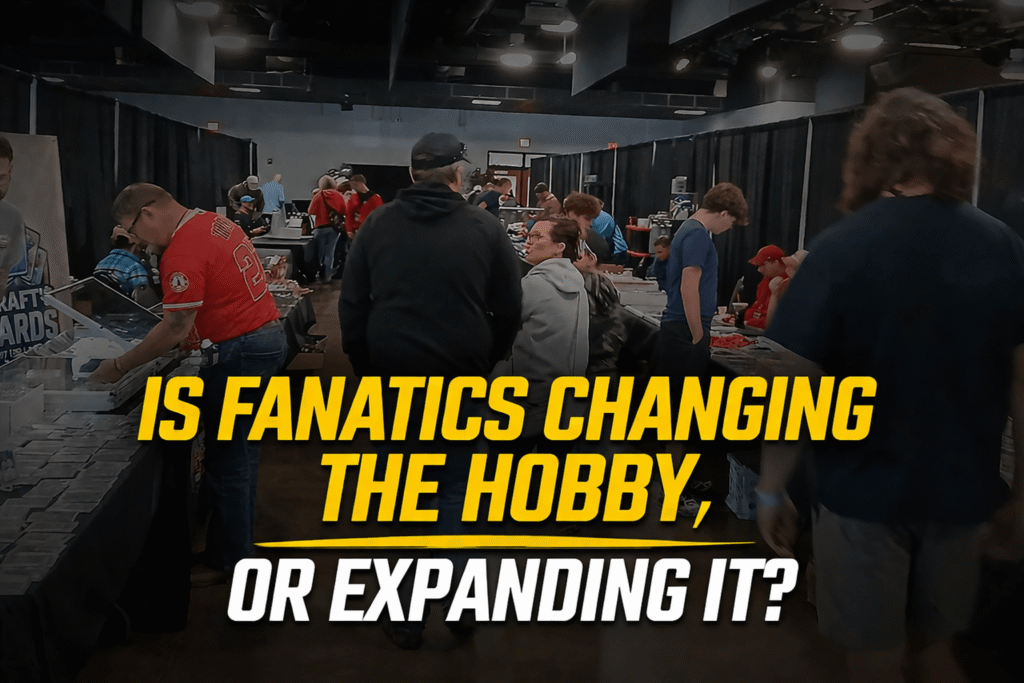
What’s clear is that participation hasn’t dropped off. If anything, it’s gone the other direction. Shows are crowded. Tables are busy. People are still digging through boxes, making deals, and talking cards the same way they always have.
The environment around it may look different, but the core behavior hasn’t changed.
Collectors still collect.
It’s also worth saying this isn’t a fixed position.
The hobby moves fast. Products change. Companies adjust. What feels accurate today might not hold up a year from now. There’s nothing wrong with reassessing as things evolve.
For now, both sides of the argument have merit.
Growth can push the hobby forward. It can also create friction. Tradition keeps the identity intact, but it can limit how far things go.
The real question isn’t whether Fanatics is good or bad for the hobby.
It’s whether the hobby can grow without losing what made people care about it in the first place.