
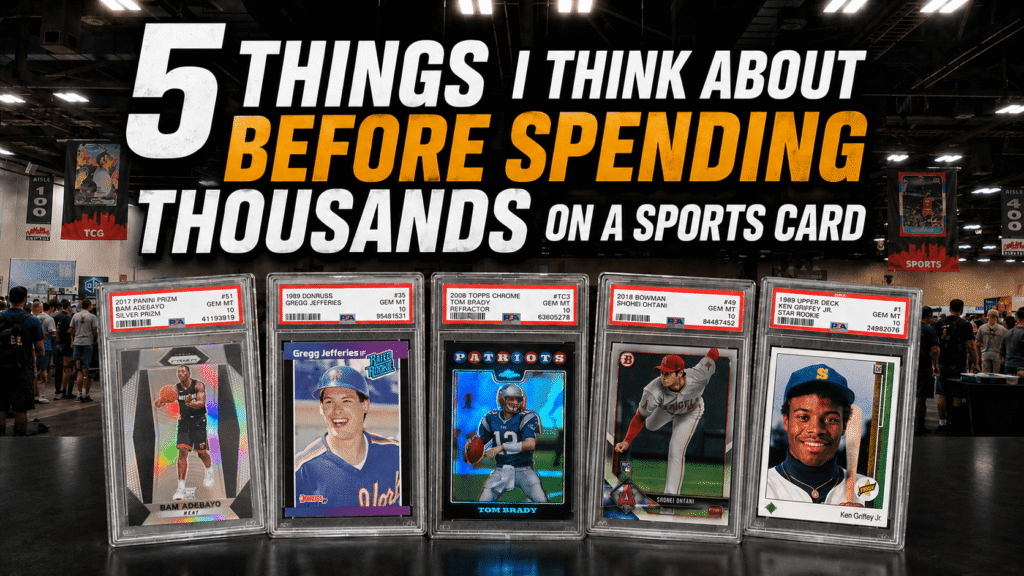
Published July 18, 2026
Deciding what to buy and add to your personal collection can be difficult, especially when you’re searching for cards that you hope will maintain or increase in value over the long run. Sometimes the decision is easy, particularly if you collect a certain team, player or parallel, or simply like the look of a particular insert. Other times, it can be much harder because there are so many options to choose from.
What holds value long term? What are your goals for your personal collection?
Having gone through this thought process dozens of times before making higher-end purchases, I thought it would be a good time to share what that process looked like for one of my recent purchases, along with the checklist I use to narrow down the options. The market is on fire, which makes these decisions tougher than ever. Hopefully, this checklist helps you make more informed choices for your own collection.
Ignore the Hype
I remember reading Beckett as a kid, and every month the Hot and Cold lists were among my favorite features in the magazine. They gave you an indication of who was trending in the right direction and which players collectors were actively searching for.
But this can also be a trap, as players who are trending often do so for only a short period before cooling off. Names like Gregg Jefferies, for example, might not even sound familiar to modern collectors, but at one time he was a hot MLB prospect and hobby darling whose popularity cooled substantially over the years.
Few prospects have generated as much hobby excitement as Gregg Jefferies. Before he had established himself in the majors, Star Company released an entire 11-card set dedicated solely to him, a testament to just how high collector expectations had become. Today, sealed copies of that set can sell for as little as $6. Jefferies was even among the players considered for card No. 1 in Upper Deck’s inaugural 1989 baseball set before the company ultimately selected Ken Griffey Jr.
His career was far from a complete bust. Jefferies played 14 seasons, made two All-Star teams and finished with a .289 batting average, 1,593 hits, 126 home runs, 663 RBIs and 196 stolen bases. Those are the numbers of a good major-league player, but they fell well short of the superstar expectations placed on him when he entered the hobby.
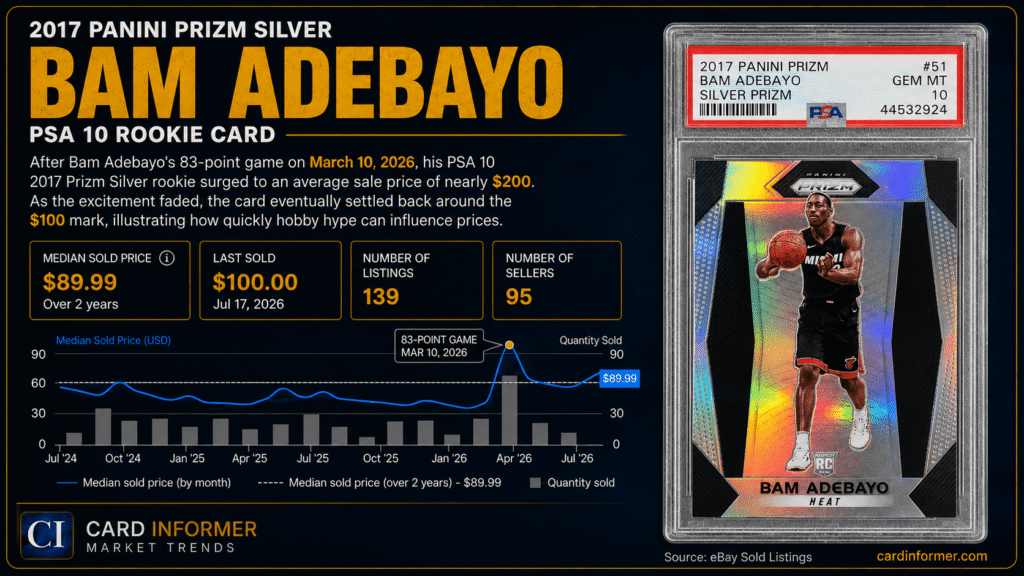
Modern examples include players like Kyler Murray, Zion Williamson, Trae Young and Ja Morant. We also saw it recently with Bam Adebayo after his historic 83-point game in March. His Silver Prizm rookie climbed close to $200 during the excitement but has since sold for as little as around $100.
If you have the appetite for risk, you might be attracted to this strategy, but tread lightly, as the majority of hot names eventually come back down to earth.
Study the Player
For the safest long-term holds, it is generally best to buy players who have already cemented their legacy. This does not mean only buying retired players. Some players are still active and remain relatively safe bets to continue increasing in value.
LeBron James, Stephen Curry, Patrick Mahomes and Shohei Ohtani are all still very much active, and in some cases have a large part of their stories left to be written. At the same time, they have already cemented their legacies as all-time greats in their respective sports. Other players, such as Aaron Judge and Victor Wembanyama, appear to be on similar trajectories but have yet to reach some of those career-defining moments and accolades.
There is basically a formula you can use when determining which players are great, or are heading toward greatness, and it is a combination of performance and marketing buzz. Michael Jordan cards are not only popular more than 20 years after his retirement because of what he accomplished on the court, but also because of his immense cultural significance. You cannot discount the second part of that equation.
Ken Griffey Jr. is another great example. While he never won a championship, he put up massive numbers throughout his career, finishing with a .284 batting average, 2,781 hits, 630 home runs and 1,836 RBIs while earning 13 All-Star selections, 10 Gold Gloves, the 1997 AL MVP Award and a first-ballot Hall of Fame induction. Those accomplishments rank him among the game’s all-time greats, while his status as a pop culture icon further cements his legacy.
Study the Card
Not all cards of Hall of Fame players are created equal. One of the best examples of this can be found in the Tom Brady rookie market. He has at least a dozen rookie cards to choose from across several notable products, including Upper Deck, Fleer and Bowman. But which of these has become recognized as “the Brady rookie”? It is the Bowman and Bowman Chrome, hands down.
Even serial-numbered rookies like the great-looking Fleer E-X rookie, which is limited to only 1,500 copies and has seen just 389 copies graded by PSA, are far less recognizable and desirable to most Brady collectors. Flagship rookies will almost always carry the most weight in the hobby. That is simply the hobby consensus.
You can also look to ultra-modern examples like Victor Wembanyama and see that his Silver Prizm rookie and similar Prizm parallels attract more interest from the market in general. This does not mean it is bad to own a Hoops Wembanyama rookie, but if you decide to go that route, just know that liquidity is generally lower and the potential buyer pool could shrink significantly if you ever decide to sell.
Don’t be afraid to pay up for the right card
When looking for certain cards of the all-time greats, it can be challenging to find them at the right price. For example, my most recent pickup, a PSA 10 2008 Topps Chrome Tom Brady Refractor (#TC3), was nowhere near the last comp, which was closer to the $1,300 mark back in January. But to me, this card checks all of the boxes for long-term value, which meant I did not mind paying strong to secure one of only 51 PSA 10 copies. For context, the 2008 Topps Chrome set features a few different Brady variations, but they don’t all command the same respect:
- TC3: The base Tom Brady card, which is the most desirable among collectors.
- TC121: The Tom Brady League Leaders card, which commemorates his then-record 4,806 passing yards.
- TC163: A card celebrating Brady’s MVP award from the 2007 NFL season.
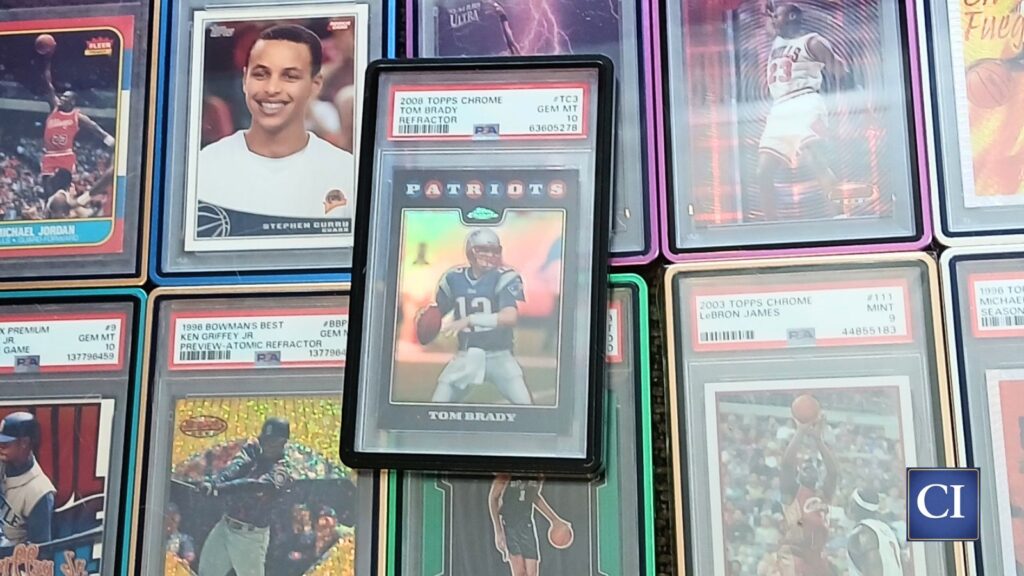
Time will tell whether I made the correct decision. I passed on serial-numbered copies of the other Brady cards in the set to pay strong for a PSA 10 of the base refractor, which does not pop up for sale every day. The Xfractor version was also hard to pass up, even though it has a population of 49 PSA 10s and a slightly lower overall population. In the end, I went with the standard refractor.
Don’t be afraid to make a stand and set a new high comp on cards of all-time greats that do not pop up for sale every day, especially when the card checks all of the boxes on your personal list. Remember, the last public or direct comp is simply a reference point, not a ceiling.
Would I still be happy owning this in five years?
This is the ultimate litmus test when deciding what to buy and hold for the long haul. At the end of the day, would you be happy holding this card for a number of years? Don’t buy a card because an influencer or hobby voice said it was one of the best cards to buy, or because you saw it in a video and thought the person discussing it made it look desirable.
Do you like the player? Do you like the look of the card? Would you still be happy holding it if it lost 50% of its value? If the answer to all of those questions is yes, then you are well on your way to finding your next target.
Closing thoughts
At the end of the day, as a collector, you have to decide what you want your collection to look like. Do you like rookies? Do you like chasing modern prospects? Do you enjoy looking for diamonds in the rough?
There is no right or wrong way to collect, but making informed decisions with the information available can go a long way. Using the combination of brand recognition and cultural relevance that we discussed earlier in this article can help you decide which pieces might continue to perform well in the decades to come.